Lice Treatments: 3 Terrible Secrets
There are three things the big lice-treatment companies do not want you to know before you grab that box of Rid or Nix. Read all the way down — Secret #3 is actually shocking!
The amount of poison
Rid and Nix contain more insecticide than a can of Raid. It sounds impossible, but the numbers are printed right on the labels.

Pick up a can of Raid Ant & Roach Killer and read the active ingredients: imiprothrin and cypermethrin.
Both are pyrethroid insecticides — the same chemical family used in Rid and Nix.
Their combined concentration? Well under one-quarter of one percent. That tiny amount kills bugs on contact — and earns the warning "keep out of reach of children."
Now read the lice-treatment boxes.
Rid contains 0.33% pyrethrum extract — roughly double the insecticide concentration in Raid.
Nix contains a full 1% permethrin — five to six times the concentration in the can of Raid.
And that's when parents follow the directions. In the panic of an outbreak, many families re-treat again and again — exposing their kids to far more than even the manufacturers intend.
Would you spray your child's head with a can of Raid? By concentration, Rid and Nix have more poison.
They don't work very well anymore
Here's the part that makes Secret #1 truly maddening: those poisons largely stopped working years ago.
Scientists have known since the 1990s.
In 1999, researchers published a study in the journal now known as JAMA Pediatrics. They collected head lice from children in two places: the United States, and Malaysian Borneo.
The lice from Borneo had never been exposed to these chemicals. Permethrin killed them, as expected.
What are Super Lice?

The lice from American children — whose parents had been buying these treatments for decades — were substantially resistant.
The researchers' conclusion: permethrin no longer reliably works on U.S. head lice.
That was 1999. It has only gotten worse.
A 2016 study in the Journal of Medical Entomology examined lice populations across 48 U.S. states. The overwhelming majority carried the gene mutations — "knockdown resistance" — that make lice immune to permethrin and pyrethrin.
This is why the news keeps running stories about "super lice." And it's why so many families treat, re-treat, and treat again… and the lice keep coming back.
So the industry's answer to a poison that stopped working has been… to keep selling the poison.
The one that should shock you
If the treatments were merely ineffective, that would be bad enough. But there's research every parent deserves to see before choosing a lice treatment.
In 2006, a peer-reviewed study in Occupational and Environmental Medicine examined pesticide exposure and childhood cancer.
One finding stood out. WebMD reported it at the time:
Children treated with insecticidal lice shampoos had roughly double the odds of developing acute leukemia.
Double. From a product parents are told to rub into their children's scalps.
To be clear: the study shows an association, not proof of cause. But it is published, peer-reviewed research — and you deserved to see it before you reached the drugstore aisle.
The National Pediculosis Association — a nonprofit that has spent decades advocating for children on this issue — has documented family accounts of the same fear, including the story of a boy named Jesse whose leukemia his mother connects to repeated lice-pesticide treatments.
Put the three secrets together:
- The drugstore treatments contain more insecticide than roach spray.
- The lice have evolved to survive them.
- Peer-reviewed research links them to doubled odds of childhood leukemia.
Why would any parent use them — and why does the industry keep quiet about all three?
The family behind the natural alternative that actually works to get rid of lice

Twenty years ago, the drugstore lice treatments failed on our own five kids. Over and over.
If the lice poisons are failing — and no parent wants poison on their child's head anyway — what would a genuinely natural lice treatment look like?
To answer that, Peter — a former organic farmer — teamed up with a PhD chemist. The answer became a two-step system:
- Enzymes dissolve the glue that cements the nits (the eggs) to the hair — the thing drugstore chemicals never touch, and the reason lice keep coming back.
- Natural essential oils kill the live lice.
No pyrethrin. No permethrin. No organophosphates.
It's gentle enough to use daily if needed. And because it works physically, not chemically, lice can't evolve resistance to it the way they did to the poisons.
Don't forget the house
Lice don't just live on heads. Stray hairs carry them to pillowcases, couches, car seats, and hairbrushes.
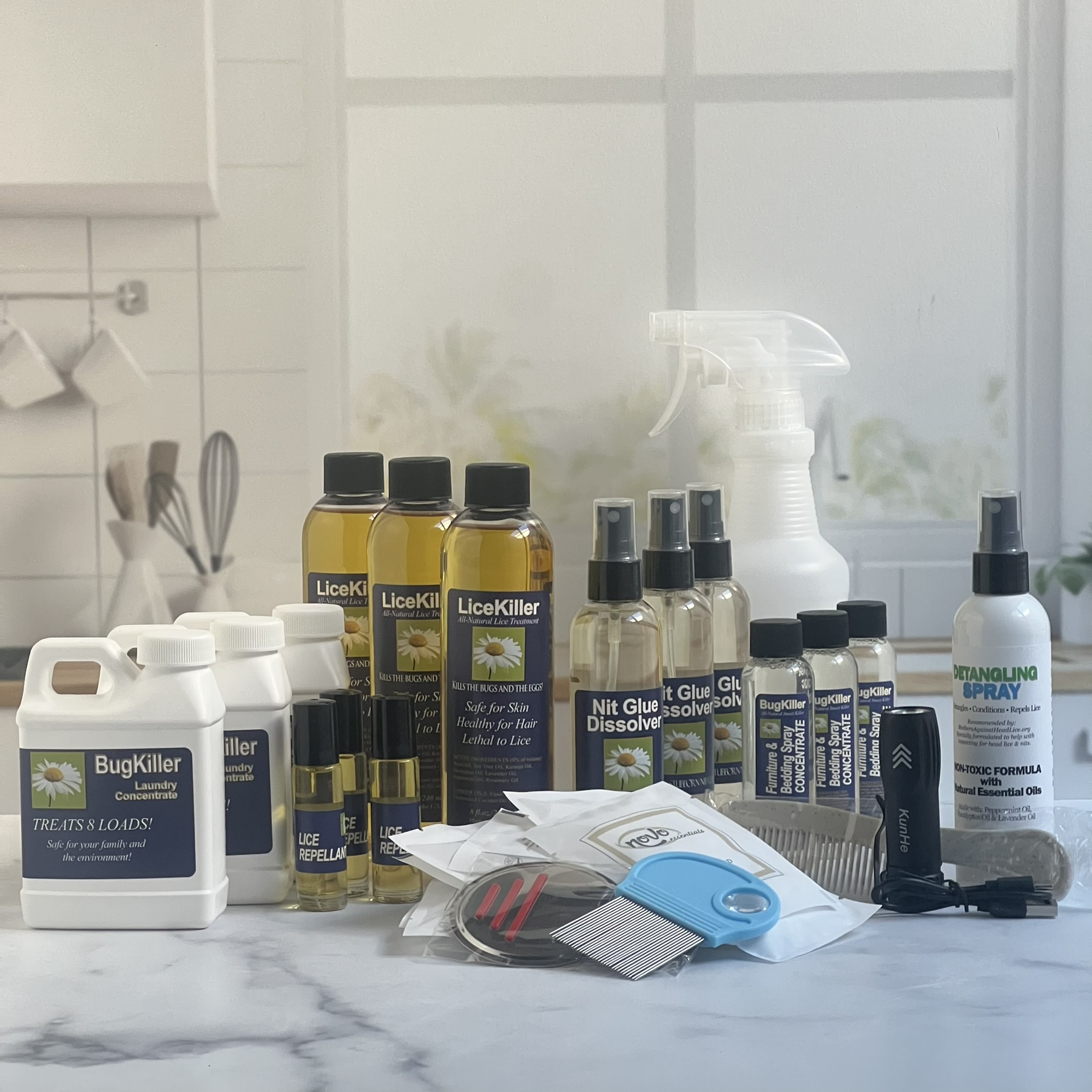
That's why our kits include a Furniture Spray for couches, car seats, pillows, and toys — and a Laundry Concentrate for clothing and bedding.
The infestation ends everywhere at once. Not just on your child's head.
And expect them to come back
Here's a hard truth: as long as other families keep using treatments that don't work, lice stay in your child's circles. School. Sleepovers. Sports. Cousins.
One exposure ends. Another begins. That's not a failure on your part — it's math.
It's why our families keep product on hand — the kits store for 5+ years on the shelf. Catch a re-infestation on day one and it's a quick, calm treatment — not a three-week nightmare.
Since then, we've helped more than 100,000 families end their infestations.
Thousands came to us after Rid or Nix had already failed them twice.
Our kits aren't the cheapest box on the shelf. But we'd rather explain a fair price than sell a poison that doesn't work. We think you'd agree.
Founders, LiceKiller · family-owned since 2004
It's all in one box: the "Everything You Need Kit"
Enzymes to dissolve the nit glue. Natural oils to kill the lice. Furniture Spray and Laundry Concentrate for your home. Step-by-step instructions refined over 20 years — every head, plus your house, in one kit.
 See the "Everything You Need" Kits
Check everything yourself
The permethrin-resistance study (1999): Pollack RJ, Kiszewski A, Armstrong P, et al. "Differential Permethrin Susceptibility of Head Lice Sampled in the United States and Borneo." Archives of Pediatrics & Adolescent Medicine (now JAMA Pediatrics), Sept 1999;153(9):969–973. Read the full study at JAMA Network
The 48-state resistance study (2016): Gellatly KJ, Krim S, Palenchar DJ, et al. "Expansion of the Knockdown Resistance Frequency Map for Human Head Lice (Phthiraptera: Pediculidae) in the United States Using Quantitative Sequencing." Journal of Medical Entomology, 2016;53(3):653–659. Read it at Oxford Academic
The leukemia study (2006): Menegaux F, Baruchel A, Bertrand Y, et al. "Household exposure to pesticides and risk of childhood acute leukaemia." Occupational and Environmental Medicine, 2006;63(2):131–134. Read it at PubMed Central
Jesse's story: the National Pediculosis Association's account of one family's experience with lice pesticides and leukemia. National Pediculosis Association (headlice.org)