For every parent who followed the directions
Last updated: September 2, 2026
Lice —
Again.
It's not your fault. The treatment you bought doesn't work any more. You didn't know.
You did everything right. Here's why they came back anyway.
You applied the product, waited the full time, combed, washed the bedding, bagged the stuffed animals. Two weeks later, they're back. After 20 years and 100,000+ families, we can tell you exactly what happened — and how to make this the last round.
There are three ways lice come back, and all three are real. Lice that survived the product. Eggs that stayed glued to the hair and hatched. Or a new case, picked up from another head or from somewhere in your home. The drugstore box only ever tried to handle the first one — and it failed at that too:
98%
of U.S. lice are now genetically resistant to the pesticides in Nix and RID¹
0
drugstore or prescription treatments dissolve nit glue — the cement holding eggs to the hair
7–10
days later, the eggs that stayed glued in place hatch — and it all starts over
And there's a third place lice live: off the head. Viable nits and live lice turn up on pillowcases, upholstery, car-seat headrests, hats, and hairbrushes, and a single one is enough to start you over. So the box failed at its one job, the eggs it couldn't touch hatched on schedule, the reservoir it never mentioned sat there waiting — and you got the blame.
The fix closes all three at once. It's natural, and most families finish it in one session.
Short version: You need one of our "Everything You Need Kits" that helps you kill resistant lice, dissolve the nit glue, and treat your home — the three jobs that end this for good.
See Your Kit OptionsFree 2-day FedEx · 5-Year Better-Than-Risk-Free Guarantee · 100,000+ families helped
The pattern you've been living
The treatment cycle — why it can go on for months
If this calendar looks familiar, it's because the cycle runs on the lice life cycle, not on anything you did wrong:
One incomplete treatment = an infestation on repeat
Day 0
You find lice and treat with Nix or RID. You comb out every nit you can catch.
Days 1–6
Hair looks clear. No live lice. You think it worked.
Days 7–10
The nits still glued to the hair hatch. Itching returns — and it looks exactly like a brand-new case.
Days 14–24
You treat again — same product, same result. The survivors mature and lay 6–10 eggs a day.
↻ Back to Day 0 — now with overlapping generations
At that point the infestation is self-sustaining. We hear from parents who've been in this loop for 3, 6, even 12 months — treating and retreating without ever fully removing the eggs.
You weren't losing to the lice. You were losing to the products.
The three things nobody prints on the box
Failure #1: the poison doesn't work anymore
98.3%
of U.S. head lice carry the genetic mutation (kdr) that makes them resistant to permethrin (Nix) and pyrethrin (RID)
Journal of Medical Entomology, 2016¹ — confirmed by a 2023 meta-analysis²
The resistance is inherited — resistant lice have resistant babies. And switching from Nix to RID doesn't help: both attack the same pathway in the louse's nervous system, and the mutation blocks both. Two different keys that don't fit the same changed lock.
Failure #2: nothing on the shelf dissolves nit glue
When a louse lays an egg, she cements it to the hair shaft with a protein adhesive — nit glue — that bonds to the hair itself. It hardens in minutes and it is remarkably tough:
Combing can't catch every nit — the glue is strong enough that comb tines slide right over eggs laid close to the scalp, especially in thick, curly, or long hair. Pesticides target the nervous system of live lice; they have zero chemical effect on the glue. Vinegar, mayonnaise, and oils were tested in a clinical study — none were effective against the eggs.⁶
Nit glue is a protein. Breaking down a protein takes an enzyme. That's not marketing — it's chemistry. And it's the step nearly every treatment protocol skips, which is why nearly every treatment protocol produces the cycle above.
Failure #3: the box stops at the head
Lice and viable nits survive off the head. They turn up on pillows and bedding, on upholstered furniture, on car-seat headrests, on hats, and on shared brushes.⁴ Treat every head in the house perfectly and leave that reservoir in place, and you have simply scheduled the next round.
This is also the route that stays open after you've won. Once the infestation is cleared, the next case comes from a head your child touches — at school, at a sleepover, at practice. That is a genuinely new case, and it has nothing to do with whether your first treatment worked. It's why we send an Inspection Kit with the Large Kit, why our kits keep for five years on a shelf, and why any customer can reorder at half price for five years. We'd rather you be ready than surprised.
The whole argument in one chart
Three jobs. One product that does all three.
Three routes back means three jobs, done in the same session. Here's how the options stack up:
| What it takes to end this | Nix / RID | Home remedies | LiceKiller Kit |
|---|
| Kills today's resistant lice | ✗ | ✗ | ✓ |
| Dissolves nit glue, removes every egg | ✗ | ✗ | ✓ |
| Treats your home, car & laundry | ✗ | ✗ | ✓ |
| The result | The cycle continues | The cycle continues | The cycle ends |
Our kits pair an essential-oil formula that kills lice through a physical mechanism resistance can't beat, with an enzyme Nit Glue Dissolver that breaks down the cement so eggs slide off in one combing — plus Furniture Spray and Laundry Concentrate for everywhere lice hide off the head.
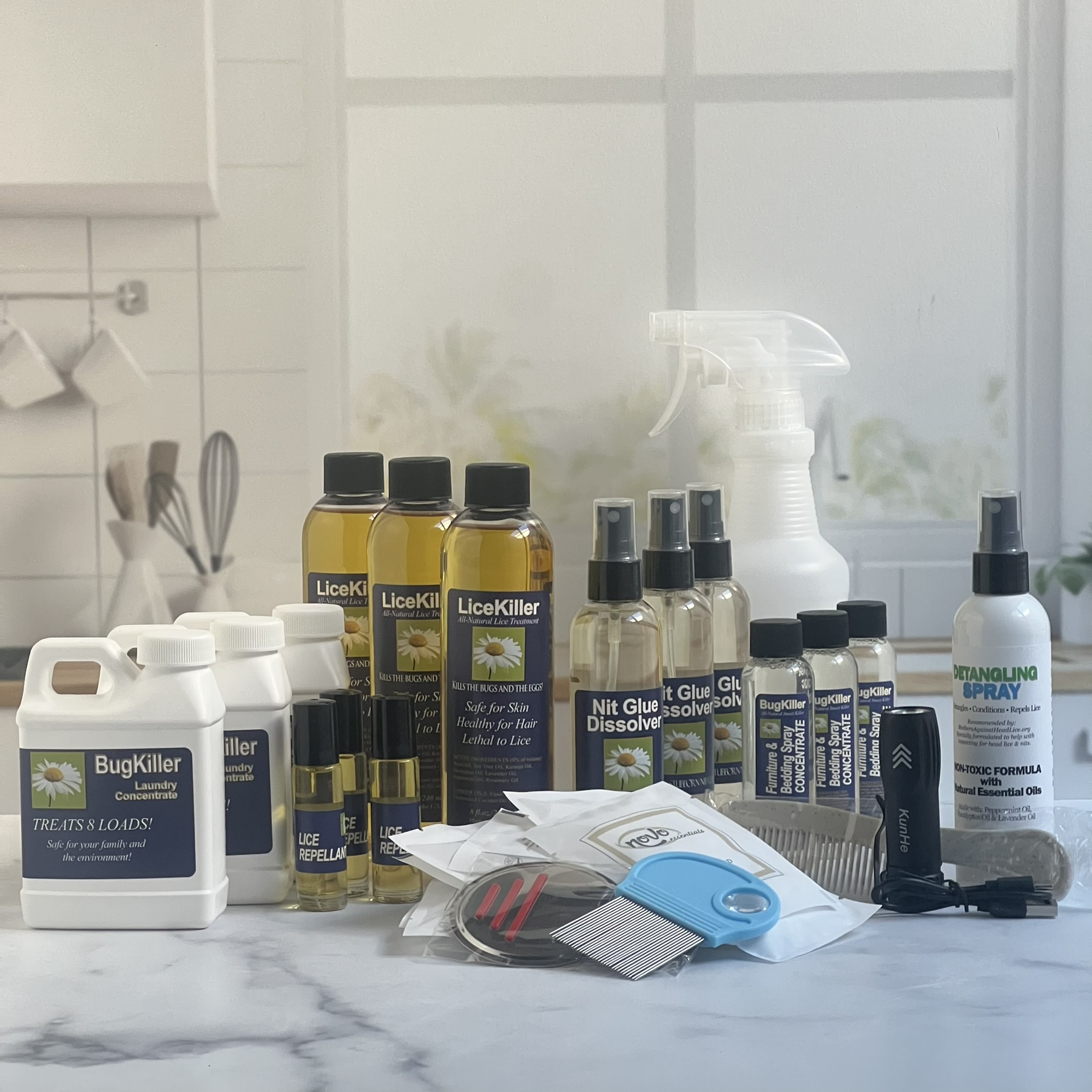
The "Everything You Need Kit" — all three jobs in one box. Large Kit $169.95 with the $39.95 Inspection Kit free · Medium $149.95 · Small $109.95.
Choose Your KitFree 2-day FedEx · Buy Now, Pay Later available at checkout
The exit
How to actually break the cycle — one session
- Kill the resistant lice. The essential-oil formula works through a mechanism the kdr mutation can't block — no waiting period, safe enough to use the moment you spot anything.
- Dissolve the glue and get every egg out. The enzyme formula degrades the protein cement, so nits slide off during combing instead of clinging through every pass. This is the step that prevents Day 7–10 from ever happening.
- Treat your home the same day. Furniture Spray on couches, car seats, and mattresses; Laundry Concentrate in the wash; hot dryer; vacuum. No reservoir left to restart anything.
Done together, the infestation has nowhere to hide: no surviving adults, no viable eggs, no environmental source. Check again in 7–10 days as insurance, and you're done — actually done.
From customers who came to us on their own — never solicited, never AI
Families who were exactly where you are
Kathy recorded this herself in 2008 and put it online without telling us. She had spent about $70 on drugstore treatments, treated her family twice with no result, then filled a prescription from her doctor that frightened her and didn't work either. She was roughly a month in before she found us. It's an old home video and we've never replaced it with anything slicker, because this is what actually happened.
★★★★★
"For 6–8 months I fought head lice on my granddaughter. I tried everything — I even threw out her clothes, her furniture, the carpet. One treatment with your product and I have never seen lice on her again."
— Terry, Fallbrook, CA
★★★★★
"We did a full week of Nix — 90 minutes of combing every day. One week later she had a head full of live lice. We took a chance on your product. It worked exactly like you said."
— Dawnya, Lawrenceville, GA
★★★★★
"A vicious cycle of repeated infestations, and I didn't want chemicals on my babies. It has now been 3 months lice-free — the first time in years it hasn't come back within a week."
— Stacy, Apex, NC
We've never asked a customer for a testimonial since 2004. Every quote above came in an email someone sent us on their own, and Kathy made her video without us knowing about it.
Quick reference
Six mistakes that keep the cycle going
1. Retreating with the same product. If Nix or RID didn't work the first time, genetics guarantee it won't work the third time either.
2. Switching Nix ↔ RID. Both target the same pathway; the same mutation defeats both.
3. Combing without dissolving the glue. Even the best metal comb can't catch every cemented nit. The ones you miss will hatch.
4. Treating heads but not your home. A single viable nit on a pillowcase or car-seat headrest can restart everything.
5. Stopping after one treatment. Recheck in 7–10 days — cheap insurance against any egg that slipped through.
6. Guessing instead of checking. Lice back within 7–10 days fit the hatch window of eggs left behind. Lice back weeks after a clean recheck fit a new case. Look before you conclude — it tells you whether to finish the job or start a fresh one.
Zero risk
Our 5-Year Better-Than-Risk-Free Guarantee
✓
If our products don't kill the lice you see — full refund within 60 days. No hoops, no delays.
✓
If lice come back from school or a sleepover anytime in the next 5 years — reorder at 50% off. (Kits last 5+ years on the shelf.)
After a few rounds with products that failed and kept your money anyway, you've earned a guarantee that runs the other direction.
Who's telling you this
We built it because the poison failed our own five kids

Twenty years ago the drugstore treatments failed on our five kids — over and over. The same cycle you're in right now.
So Peter, a former organic farmer, teamed up with a PhD chemist and built the two-step system: enzymes dissolve the nit glue, then natural essential oils kill the lice — physically, not chemically, so resistance can't evolve against it. No pyrethrin. No permethrin. Gentle enough to use daily. More than 100,000 families since.
Lisa & Peter Dudek
Founders, LiceKiller · family-owned since 2004
Your re-infestation defense
The Lice Inspection Kit: know in 60 seconds, not 3 weeks
Once this round is over, the third route stays open. Your child goes back to the same classroom and the same sleepovers, and a brand-new case can walk right in. The families who stay lice-free are the ones who catch it on day one, when it's a 10-minute fix — not three weeks later, when it's the whole house again.
How it works
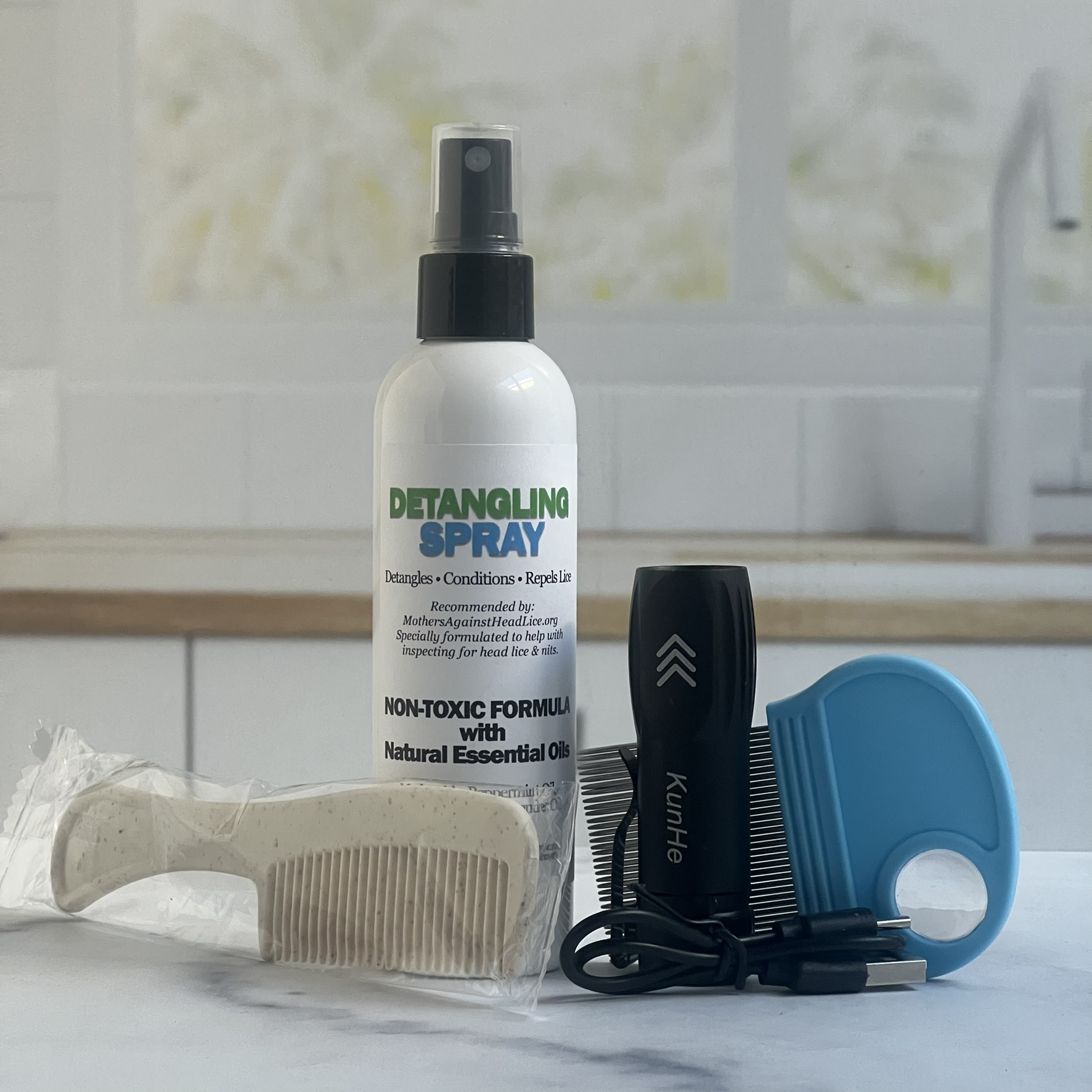
The UV black-light flashlight makes nits glow against the hair, so a full head-check takes about 60 seconds. Once a week during school season — that's the whole routine. Spot something? You already have the treatment on your shelf, and it's over the same night it started.
Sold separately: $39.95 — free with your Large Kit
What's in the Inspection Kit: UV Black-Light Flashlight ×1 · Fine-Tooth Lice Comb with Magnifier ×1 · Wide-Tooth Detangling Comb ×1 · LiceKiller Detangling Spray, which repels lice ×1
This is also why we put a 5-year, 50%-off reorder on every purchase and why the kits keep on a shelf for five years. We would rather you were ready than surprised.
Everything in one box
Choose your kit
Every kit does all three jobs — kills resistant lice, dissolves the nit glue so the eggs come out, and treats your home, car, and laundry. The only difference is how much product you get.
Most families choose this
Large Kit + FREE Inspection Kit
For families of 4 or more · treats a 3–4 bedroom home
$169.95
Free 2-day FedEx · includes the FREE $39.95 Inspection Kit
Buy these separately (with the Inspection Kit): $426.50 · in this kit: $169.95 — you save $256.55 (60%)
What's in the box
Nit Glue Dissolver 4 oz ×3 · LiceKiller Oils 8 oz ×3 · Lice Repellent ×3 · Furniture Spray Concentrate ×3 · Laundry Concentrate 8 oz ×3 · Sprayer Bottle · Premium Metal Lice Comb · Lice Comb with Built-In Magnifier · 7 Shower Caps · Instructions
+ Free Lice Inspection Kit ($39.95 value — the 60-second check above)
UV Black-Light Flashlight · Fine-Tooth Lice Comb with Magnifier · Wide-Tooth Detangling Comb · Detangling Spray (repels lice)
Add Your Large Kit — $169.95 · Free ShippingBacked by our 5-Year Better-Than-Risk-Free Guarantee
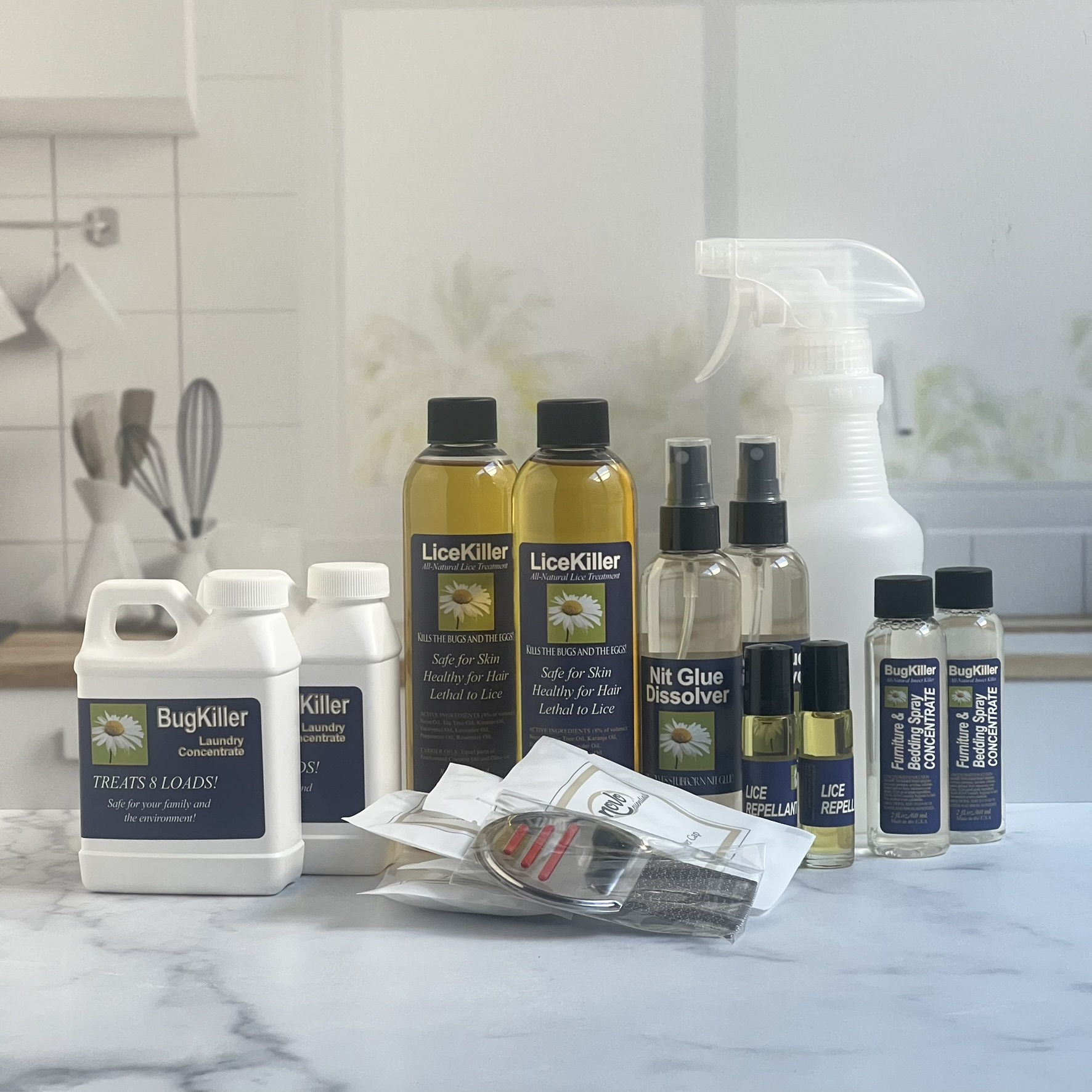
Medium Kit
For 2–3 people · treats a 2-bedroom home
$149.95
Free 2-day FedEx
Buy these separately: $257.70 · in this kit: $149.95 — you save $107.75 (42%)
What's in the box
Two of every product in the system (Dissolver, Oils, Repellent, Furniture Spray, Laundry Concentrate), both combs, 5 shower caps, instructions.
For just $20 more, the Large gives you a third of every product plus the $39.95 Inspection Kit free — and everything keeps up to 5 years stored cool and dark, so it's on hand if you need it again.
Add Your Medium Kit — $149.95Backed by our 5-Year Better-Than-Risk-Free Guarantee
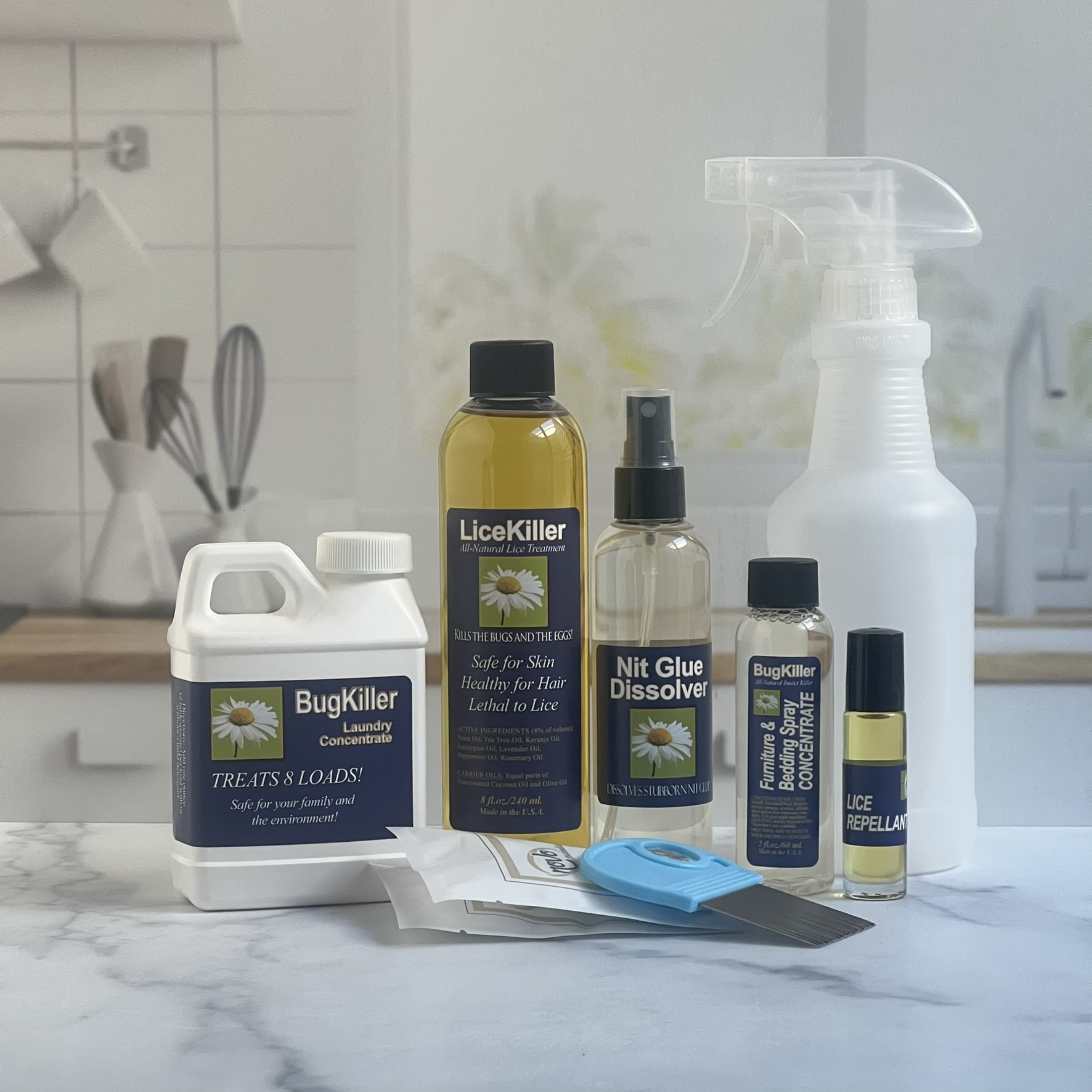
Small Kit
For 1 person · a small space
$109.95
Free 2-day FedEx
What's in the box
One of each product, magnifier comb, 5 shower caps, instructions.
For just $40 more, the Medium doubles every product. Everything keeps 5+ years on the shelf.
Add Your Small Kit — $109.95Backed by our 5-Year Better-Than-Risk-Free Guarantee
Still have questions?
Frequently asked questions
Why do lice keep coming back after treatment?
There are three routes, and all three are real. Survivors: 98% of U.S. lice carry a mutation that defeats the pesticides in Nix and RID, so live lice walk away from the treatment. Eggs: nits are cemented to the hair with a protein adhesive called nit glue that no OTC pesticide, prescription treatment, or home remedy dissolves, and the ones left behind hatch in 7 to 10 days. Re-exposure: lice come from another head, or from viable nits and lice on bedding, upholstery, car seats, hats, and brushes. Timing is your clue to which one you're dealing with — but a product that only kills live lice on the head leaves two of the three routes wide open.
I can't get rid of lice — what am I doing wrong?
Most likely nothing. The problem is the products, not the parent. Over-the-counter treatments like Nix and RID fail against 98% of U.S. lice due to widespread genetic resistance. Even when live lice are killed, the nits remain cemented to the hair because these products have no effect on nit glue. The solution requires three things most OTC products do not provide: a formula that works against resistant lice, an enzyme that dissolves nit glue for complete egg removal, and treatment of the home environment.
Why does my child keep getting lice from school?
School re-exposure is real. Lice spread through direct head-to-head contact, and classrooms, sleepovers, and sports supply plenty of it. Timing helps you tell which situation you're in. Lice showing up 7 to 10 days after treatment line up with the hatch window of eggs that were never removed. Lice showing up weeks later, after a recheck came back clean, are more consistent with a new case. Either way the response is the same three jobs: kill the lice, dissolve the nit glue so every egg comes out, and treat your home the same day so nothing survives off the head.
Can lice become immune to treatment?
Lice have already become immune to the most common treatments. A 2016 study found that 98.3% of head lice in the United States carry a genetic mutation called knockdown resistance (kdr) that makes them immune to permethrin (Nix) and pyrethrin (RID). This resistance is inherited — when resistant lice reproduce, their offspring are also resistant. Treatments that use different mechanisms, such as essential oil-based formulas, bypass this resistance because they do not target the same biological pathway.
How many lice treatments does it take to get rid of lice?
With a comprehensive protocol that kills resistant lice, dissolves nit glue for complete egg removal, and treats the home environment, most families resolve the infestation in one treatment session with a follow-up check in 7 to 10 days. When families report needing multiple treatments over weeks or months, it is usually because the treatment being used does not address nit glue, so eggs survive and hatch after each round.
Should I use Nix or RID if lice keep coming back?
No. If lice have survived one application of Nix or RID, they are genetically resistant and reapplying the same product will not produce a different result. Switching from Nix to RID (or vice versa) also does not help because both products target the same biological pathway. You need a treatment that works through a different mechanism entirely, such as an essential oil-based formula, combined with an enzyme-based nit glue dissolver to ensure all eggs are removed.
Do I need to treat my house if lice keep coming back?
Yes. Lice and viable nits can survive off the head on pillows, upholstered furniture, car seat headrests, hats, hair brushes, and bedding. If you treat the hair but not the environment, lice from these sources can recolonize the hair. Use an enzyme-based environmental spray on upholstered surfaces, wash bedding and recently worn clothing in hot water with high-heat drying, and vacuum upholstered furniture and rugs.
What dissolves nit glue?
Nit glue is a protein-based adhesive that forms cross-linked bonds with human hair. It can be broken down by proteolytic enzymes — enzymes that specifically target and degrade protein bonds. When an enzyme-based nit glue dissolver is applied, it softens and degrades the cement so that nits slide off easily during combing. Pesticides, vinegar, mayonnaise, olive oil, and other commonly recommended remedies have no effect on nit glue because they do not contain the enzymes needed to break down its protein structure.
Can my child get lice again after a successful treatment?
Yes. Once an infestation is fully cleared, a new one can start any time your child has head-to-head contact with someone who has lice. That's a genuinely new case, not a failure of the first treatment, and it's the one route no product can close permanently. What you can do is catch it early and be ready: check heads periodically, especially after sleepovers and at the start of a school term, and keep treatment in the house. Our kits stay good on the shelf for five years, and any LiceKiller customer can reorder at 50% off for five years after purchase.
How long can a lice infestation last if not properly treated?
Indefinitely. A female louse lives approximately 30 days and lays 6 to 10 eggs per day. Those eggs hatch in 7 to 10 days, and the new lice mature to egg-laying adults within another 9 to 12 days. Without complete elimination of both live lice and all nits, overlapping generations sustain the infestation continuously. Some families report dealing with lice for 3, 6, or even 12 months before finding a treatment that addresses the nit glue problem.
The receipts
Sources
- Yoon KS, et al. "Expansion of the Knockdown Resistance Frequency Map for Human Head Lice in the United States Using Quantitative Sequencing." Journal of Medical Entomology. 2016;53(3):653–659.
- Mohammadi J, et al. "Evaluation of resistance of human head lice to pyrethroid insecticides: A meta-analysis study." 2023. PMC.
- American Academy of Pediatrics. "Head Lice." Pediatrics. 2022;150(4).
- Burkhart CN, Burkhart CG. "Fomite transmission in head lice." Journal of the American Academy of Dermatology. 2007;56(6):1044–1047.
- Downs AMR, Stafford KA, Harvey I, Coles GC. "Evidence for double resistance to permethrin and malathion in head lice." British Journal of Dermatology. 1999;141(3):508–511.
- Takano-Lee M, Edman JD, Mullens BA, Clark JM. "Home Remedies to Control Head Lice: Assessment of Home Remedies to Control the Human Head Louse, Pediculus humanus capitis." Journal of Pediatric Nursing. 2004;19(6):393–398.